

Filters / Air Filters
Air filters,
protection in every airflow.
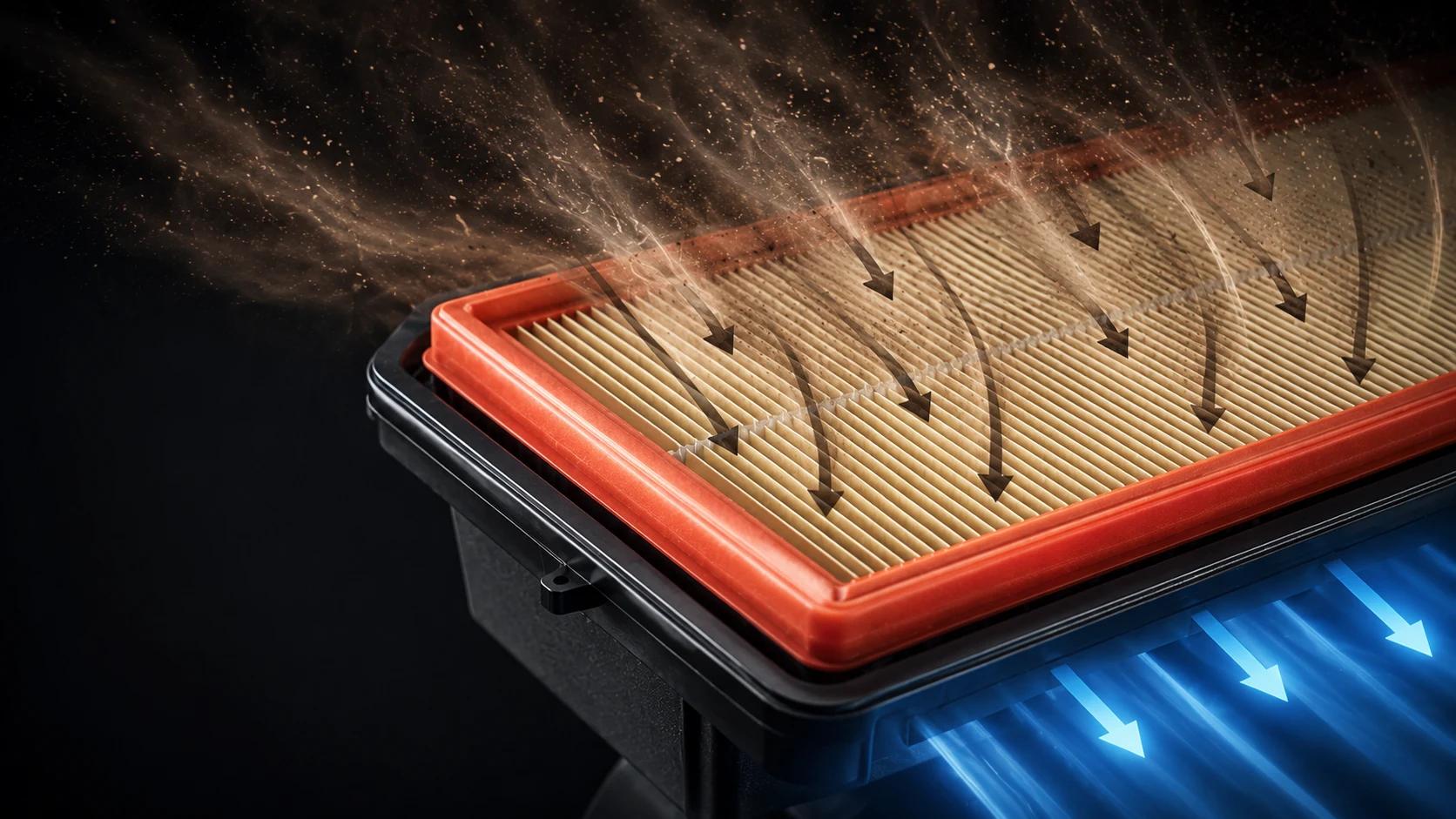
Against airborne dust, particles and contamination, reliable filtration performance is delivered at every airflow, every duty cycle and across changing operating conditions.
Overview
Air filters,
engineered for performance.
Clean intake air is one of the fundamental conditions for engine life. From a 1.0 L passenger car engine to a 16 L heavy-duty diesel, from industrial gas turbine inlets to demanding off-highway applications, every system needs an air filter that holds its performance across varying temperatures, dust loads and duty cycles.
Fil Filter engineers each air filter around the application's OE airflow requirements, dust profile, media selection and pleat geometry. The result is not an off-the-shelf approximation but a filtration element developed with engineering judgement against the operating conditions of the actual system.

Why It Matters
Measurable engine protection
against invisible contamination.
Filter performance is often invisible until its absence is felt. A properly engineered air filter shows its effect not only in laboratory numbers but at the wheel, on the dyno, in fuel consumption and at the next service teardown.
Engine Protection
Fine airborne particles are stopped before they reach the cylinder. Turbo blades, piston rings, bearings and bore surfaces stay protected through the service interval, with the engine running inside its expected wear tolerances.
Performance Sustained
Low-restriction, stable airflow keeps intake pressure at the level the engine expects. Instead of horsepower quietly slipping away as the filter loads, balanced performance is held across the service interval.
Fuel Economy
Healthier airflow supports cleaner combustion. The effect shows up not only on the test bench but in measurable fuel consumption and operating cost over the life of the filter.
Engineering Features
99.9% Filtration Efficiency
A purpose-developed filter medium delivers stable filtration performance across the service life. The number is not a peak figure on a spec sheet but a performance criterion held throughout actual use.
Stabilised Pleat Geometry
A dedicated pleat-spacing structure prevents adjacent pleats from collapsing or sticking together under airflow. The full media surface stays active throughout the service life and filtration performance is maintained.
Hotmelt Spiral Bead
A continuous hotmelt bead application keeps the pleat pack stable in form. Pleat spacing remains uniform under pulsation, vibration and thermal cycling.
Flame-Retardant Media
A self-extinguishing medium adds an extra safety margin in high-risk environments such as turbocharged engine bays, industrial compressor packages and indoor turbine inlets.
Pour-Cast Polyurethane Sealing
A single-piece poured polyurethane seal is designed to fit the OE housing exactly. The risk of bypass at the gasket line is reduced under thermal expansion, vibration and operating load.
Reinforced Liner Construction
Inner and outer liners are sized with the heaviest service conditions the application will see in mind. The element holds its shape and mechanical strength is supported even in the toughest operating scenarios.
Product Families
For every application,
the same engineering standard.
From the compact air-box of a passenger car to heavy-duty engines, from severe-dust field environments to industrial systems, different air-filtration needs are met with the same engineering approach, the same OE-level quality control and the same manufacturing discipline. Only form, capacity and service requirements change with the application.
A panel format widely used in passenger and light commercial vehicles; developed with pleated cellulose media reinforced by synthetic fibres in a precision-fit frame. High filtration efficiency is delivered in a compact volume, optimised for the airflow, dust load and service interval requirements of road vehicles.
Best For
Passenger, SUV and light commercial platforms with a compact air-box design, controlled airflow and moderate dust load.
Construction
Where It Serves
Engineered for the field,
validated in the lab.
Applications
Frequently Asked Questions
Technical questions,
short answers.
How often should an air filter be replaced?
- The interval follows the manufacturer's service plan and is usually longer than the oil change interval. Dusty roads, construction and agricultural duty load the filter faster, so the interval is shortened and intermediate checks are made.
Can an air filter be cleaned and reused?
- Paper media is not designed to be cleaned with compressed air or water. Compressed air opens tears between the pleats that are invisible to the eye, and unfiltered air then reaches the engine. A filter not explicitly marked as washable is replaced, not cleaned.
Does a clogged air filter increase fuel consumption?
- A loaded filter raises intake restriction. Because the engine control unit corrects the mixture from the measured air mass, power loss and higher consumption appear together; on turbocharged engines the turbo also works harder.
What is the difference between panel and cylindrical air filters?
- The difference is the housing geometry, not the filtration principle. Panel types are common in passenger cars; cylindrical types give commercial vehicles and off-highway machines more media area and higher dust holding capacity.
Related Articles
Technical reading
on the same subject.
The Air-Filter Gasket: Small Detail, Big Impact
The moment air leaks past the gasket, the entire filtration engineering above it becomes irrelevant. Why the gasket is the part that has to work first.

Does the Air Filter Really Save Lives?
It looks like a small consumable on the service list. In fact it is the part that decides whether the turbo blade lives to 200,000 km or fails at 50,000.

Air Filter: Replace or Clean?
Compressed-air cleaning sounds practical, but on a modern engine it does more harm than good. Here is why fitting a new element is the only honest answer.
Get in Touch
The right filter
starts with the right engineer.
Reach the office closest to you or write directly: a spec, an OE number, or a short description is enough; the engineering team responds within one business day.