

Filters / Fuel Filters
Fuel filters,
the safeguard of precision injectors.
Filtration developed against water, particulate and fuel-borne residue; injectors, pumps and the fuel system are protected under changing field conditions.
Overview
Fuel filters,
engineered for performance.
Modern common-rail diesel and direct-injection petrol systems run at very high pressures with tolerances measured in microns. Water in the fuel, particulate, storage-related contamination or ageing fuel chemistry therefore pose serious risk to injectors, pumps and fuel lines.
From passenger cars to heavy-duty trucks, from agricultural machinery to marine engines, every platform needs a fuel filter that provides reliable protection against the fuel quality variations encountered in real field conditions.
Fil Filter fuel filters are developed with multi-layer media structures that manage particle filtration and water separation together. Every reference is designed and validated with biodiesel compatibility, varying fuel chemistries, temperature changes and operating conditions in mind.

Why It Matters
Measurable protection
against unknown fuel quality.
An injector tip operates at very high pressure with micron-level tolerances. The fuel filter is the critical protection component standing between the precision injection system and fuel of variable quality.
Injector Protection
Particle and water filtration protect high-pressure injectors against wear and corrosion risk. The injection system stays inside safe operating tolerances through the full service interval.
Ready for Variable Fuel
Designed with biodiesel use, water carry-over, storage-related particulate and different fuel chemistries in mind. Performance is evaluated against real field conditions, not just ideal laboratory fuel.
Across the Full Service Interval
Filtration performance is engineered to hold through the manufacturer-specified change interval. The risk of early clogging, power loss and unscheduled service is reduced.
Engineering Features
Multi-Stage Filter Element
Combined particle filtration and water separation in a single filter; coalesced water droplets fall cleanly out of the fuel stream before they reach the injection pump.
Sub-Micron Filtration
Media grades from 2 to 30 microns, matched to the precise requirements of each injection system; never a one-size-fits-all rating.
Chemically Resistant Sealings
Elastomers selected and validated for the long-term chemistry of modern diesel, petrol and biodiesel; no swelling, no embrittlement, no leak.
Biodiesel-Ready Plastics
Polymer components specifically tested for chemical resistance against B7, B30 and B100 biodiesel blends across the full operating temperature range.
Pressure-Rated Housings
Validated to withstand the pressure and pulsation profile of high-pressure common-rail circuits without deformation or bypass.
Galvanised, Washed End Caps
End caps galvanised, washed and dimensionally checked; the filter never adds particulate to the fuel it is built to clean.
Product Families
Three product families,
across the modern fuel system.
Spin-on, cartridge and pre-filter; three architectures covering the full fuel-line, from coarse upstream protection on heavy-duty platforms down to sub-micron grades for high-pressure common-rail injection. Same media discipline, same OE-grade validation across all three.
Combined particle filtration and water separation in a single spin-on housing. Water is coalesced and dropped from the fuel stream before it reaches the high-pressure pump or injectors. The standard for many commercial and agricultural diesel platforms.
Best For
Diesel platforms where the OE design uses a spin-on disposable fuel filter with built-in water separation.
Construction
Where It Serves
Engineered for the field,
validated in the lab.
Applications
Frequently Asked Questions
Technical questions,
short answers.
How often should a fuel filter be replaced?
- The interval is defined in the manufacturer's service plan. On routes where fuel quality varies, and in tanks with a risk of water ingress, the filter loads earlier; on types with a water trap the bowl is drained at every service.
Does a fuel filter also separate water?
- Most filters used in diesel systems carry a water separation stage, and the separated water collects in the bowl below the element. Water causes corrosion and loss of lubrication in the pump and injectors, so the bowl has to be drained regularly.
What are the symptoms of a clogged fuel filter?
- Power loss at higher revs, misfiring under load, hard starting and unstable idling are typical. On common rail systems the pressure drop is also stored as a fault code.
Are diesel and gasoline fuel filters the same?
- They are not. Diesel filters are designed around water separation and finer particle retention and work at higher pressures. In gasoline systems the filter focuses on particle retention and usually sits in the supply line.
Related Articles
Technical reading
on the same subject.

Paraffin in the Fuel Filter — How It Forms and How to Prevent It
Paraffin is not a contaminant; it is a natural component of the fuel. It separates out below a temperature written on the spec sheet. Three habits keep it in the line, not on the filter.
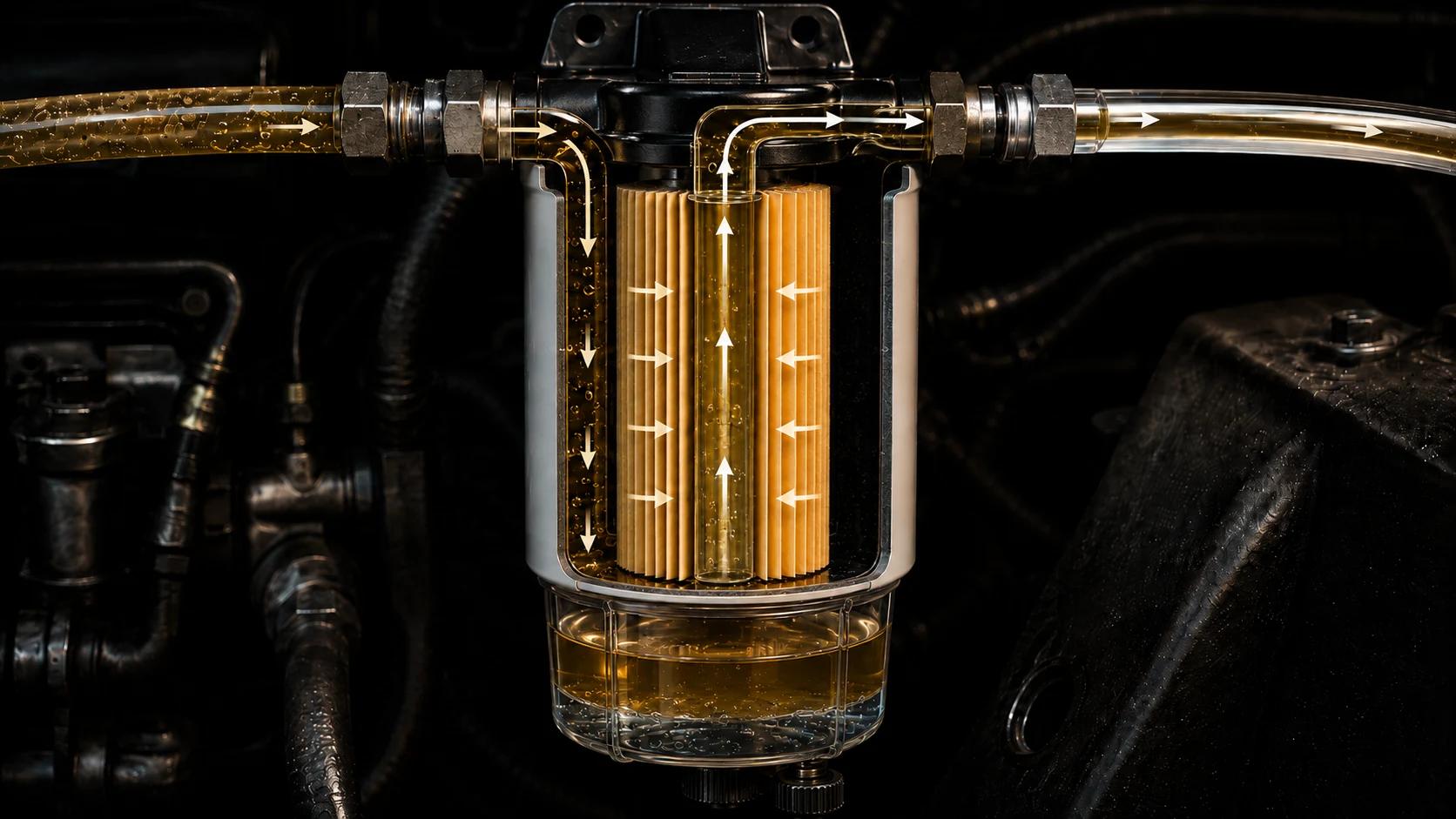
Three-Stage Water Separation in the Fuel Filter
A premium fuel filter does not separate water in one move — it separates it in three. Each stage is a layer of protection keeping modern injectors alive.

Replace the Fuel Filter Before Winter — Here's Why
A summer-loaded fuel filter and a -10 °C morning is a no-start appointment. Acting early erases most of the failures that show up on cold mornings.
Get in Touch
The right filter
starts with the right engineer.
Reach the office closest to you or write directly: a spec, an OE number, or a short description is enough; the engineering team responds within one business day.