The real engineering decision in a fuel filter is not particulate filtration — it is water separation. The one thing modern diesel injectors cannot tolerate is water droplets. A set of injectors worth thousands of euros can be wiped out by one tank of bad fuel in a single week.
First stage: coalescing the droplets
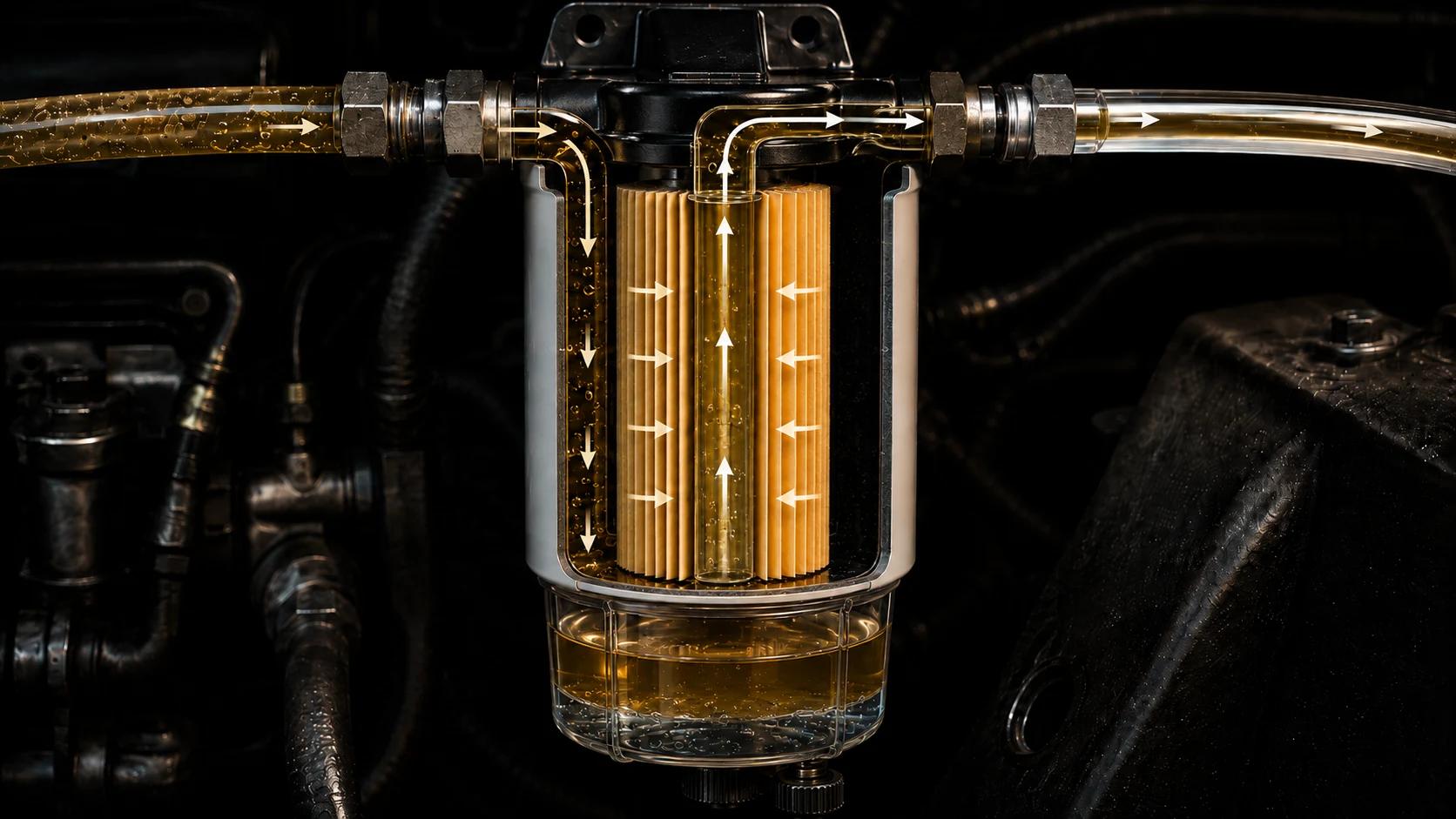
Water exists in fuel as a dissolved phase, suspended as sub-micron droplets. The droplets are too small for gravity to act on them. The first stage uses a hydrophilic microfibre paper that catches these small droplets and grows them together.
Hundreds of small droplets combine and reach millimetre scale. At that size gravity becomes useful.
Second stage: gravity separation
The coalesced droplets separate from the fuel stream by density difference. Water is heavier than diesel, so the droplets fall to the bottom of the filter housing and collect in a sump.
Premium filters add a drain plug to that sump. Emptied at the regular service interval with a simple turn of a screwdriver, the sump never overflows and the separated water never re-enters the fuel line.
Third stage: a hydrophobic barrier
A fraction of very fine droplets resist coalescing or are too small for gravity. These hit the final stage — a hydrophobic filter paper that repels water molecules and lets fuel through. It is the physical barrier that mechanically stops any remaining water from crossing.
The 98%+ water-separation rating comes from this third layer.
Two designs compared:
- Single-stage separator: 70–80% efficiency → 15–25% of water reaches the system
- Three-stage design: 98%+ efficiency → water never reaches the injector
In the field that difference shows up as ten times the injector life.