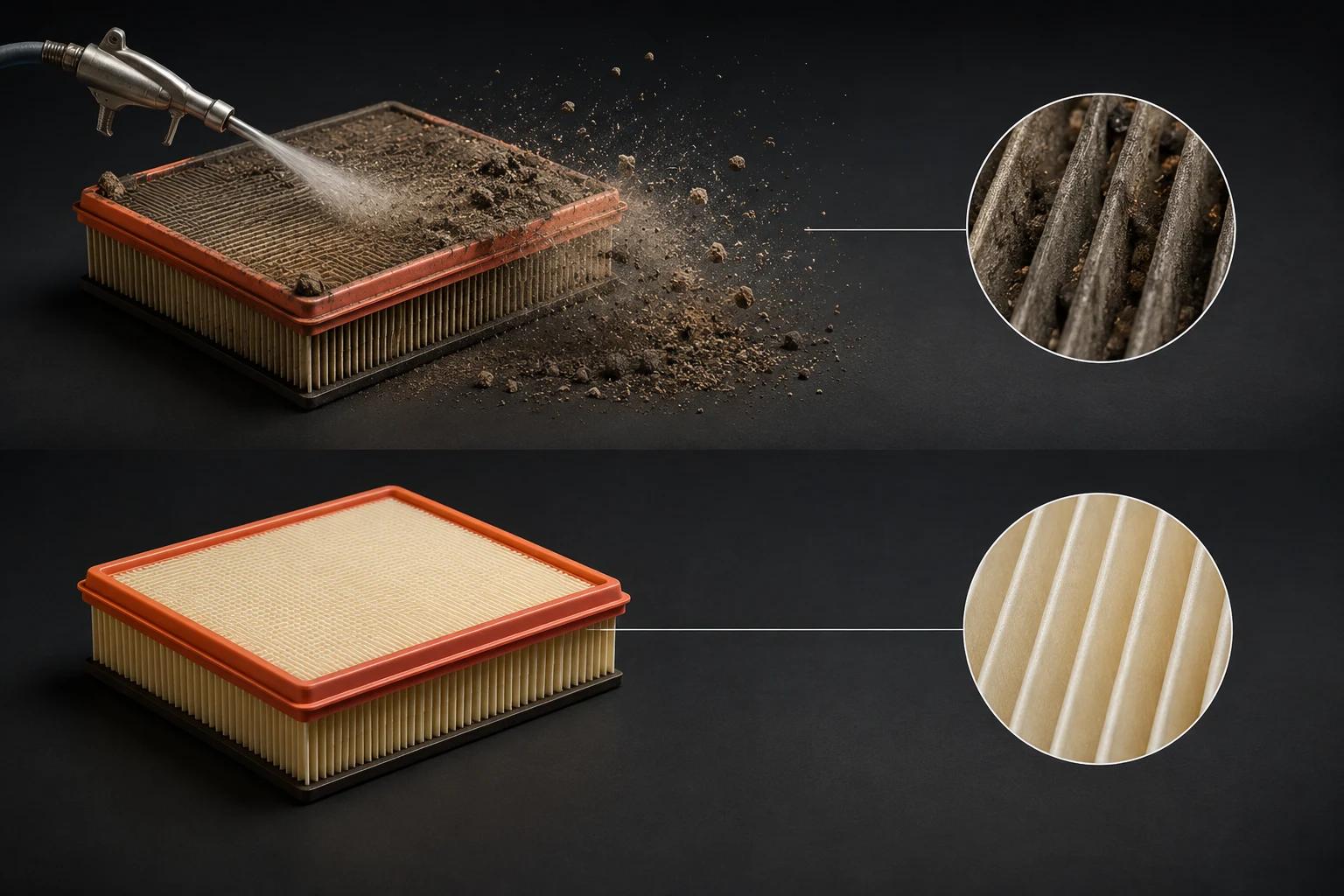
Mechanics who clean their gloves or workbench with compressed air bring the same reflex to the air filter: a quick blow-out and the element looks new. What you see is not what is happening inside.
The pleat structure does not come back
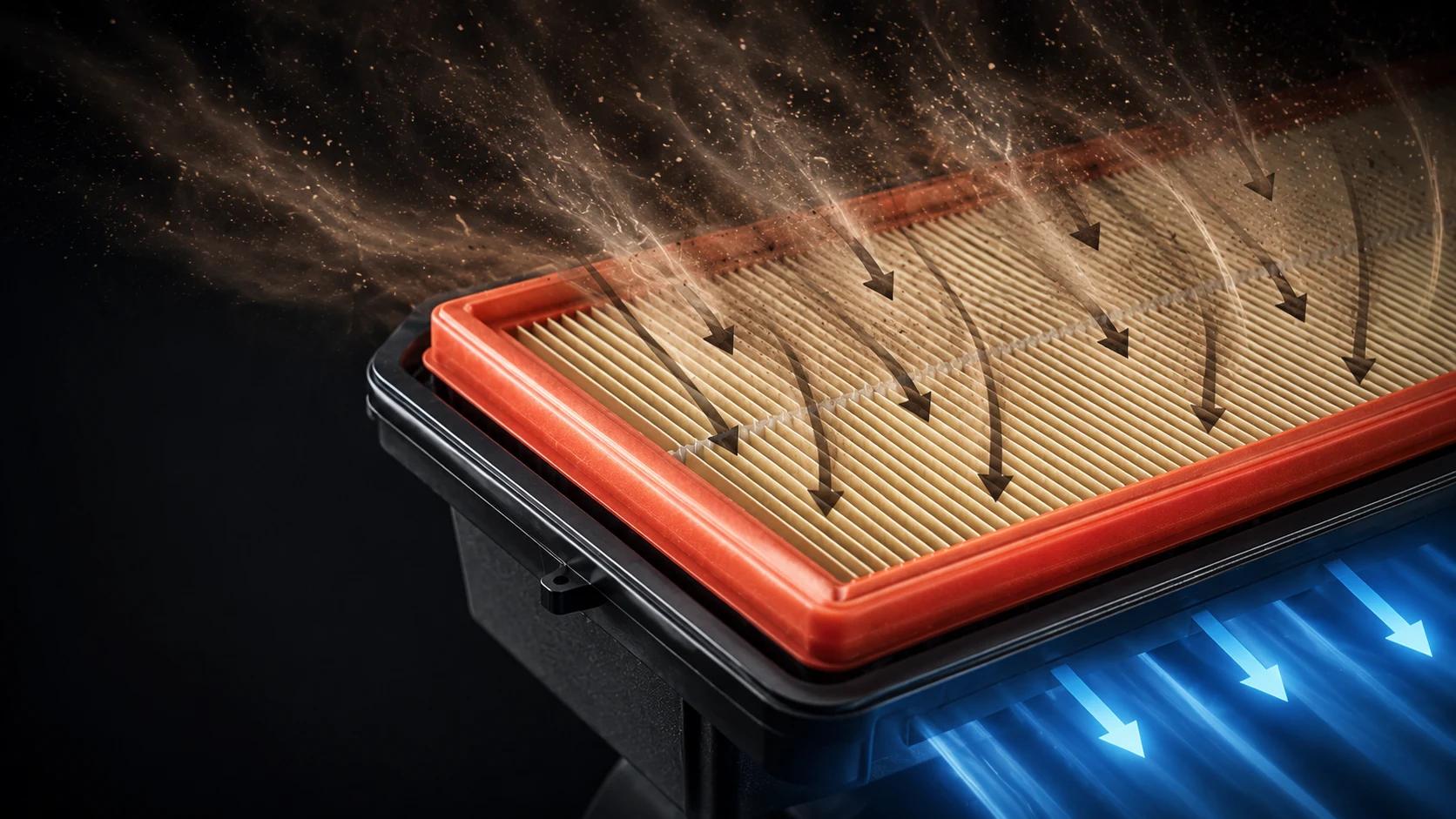
An air filter is made of pleated filter paper. The pleats are not packed densely by accident: the number of pleats determines the filter's total filtration area. A passenger-car air filter can pack 2 to 3 square metres of filtration area inside a compact housing — but only while the pleats stay properly formed.
When compressed air is applied, the pleats are forced the wrong way. Some open up, some stick together, some tear. They do not return to their original shape. The working surface is permanently reduced, and the filter's efficiency drops with it.
The dust sits where your eye cannot see it
Filter paper is not a single sheet; it is a structure woven from thousands of fine fibers you cannot see with the naked eye. Dust drawn in with the airflow lodges in the gaps between these fibers and the microscopic spaces around them, filling them up. The dust you can see on the surface is only a small fraction of what has actually accumulated.
That is why no external cleaning can remove the dust that matters. When an air filter is tested to ISO 5011, the figure measured is not just the surface catch — it is the total dust held inside the paper.
Worse: any loose dust left on the surface after cleaning gets pulled straight into the engine the next time it starts.
Manufacturers publish replacement intervals, not cleaning intervals
The replacement interval set by every engine manufacturer is built on three figures, not guesswork:
- The filter paper's dust-holding capacity (measured in grams)
- How much airflow resistance rises as the filter loads (pressure-drop curve)
- The filter paper's efficiency (per ISO 5011, up to 99.9% retention of particles in the 3–5 micron range)
A blown-out filter sits on none of those curves. Its efficiency has dropped below the catalogued figure, and its pressure balance is now unpredictable.
A shortcut that looks economical turns the engine into an off-spec unknown. The honest answer is short: replace the filter.
Filter type in this article