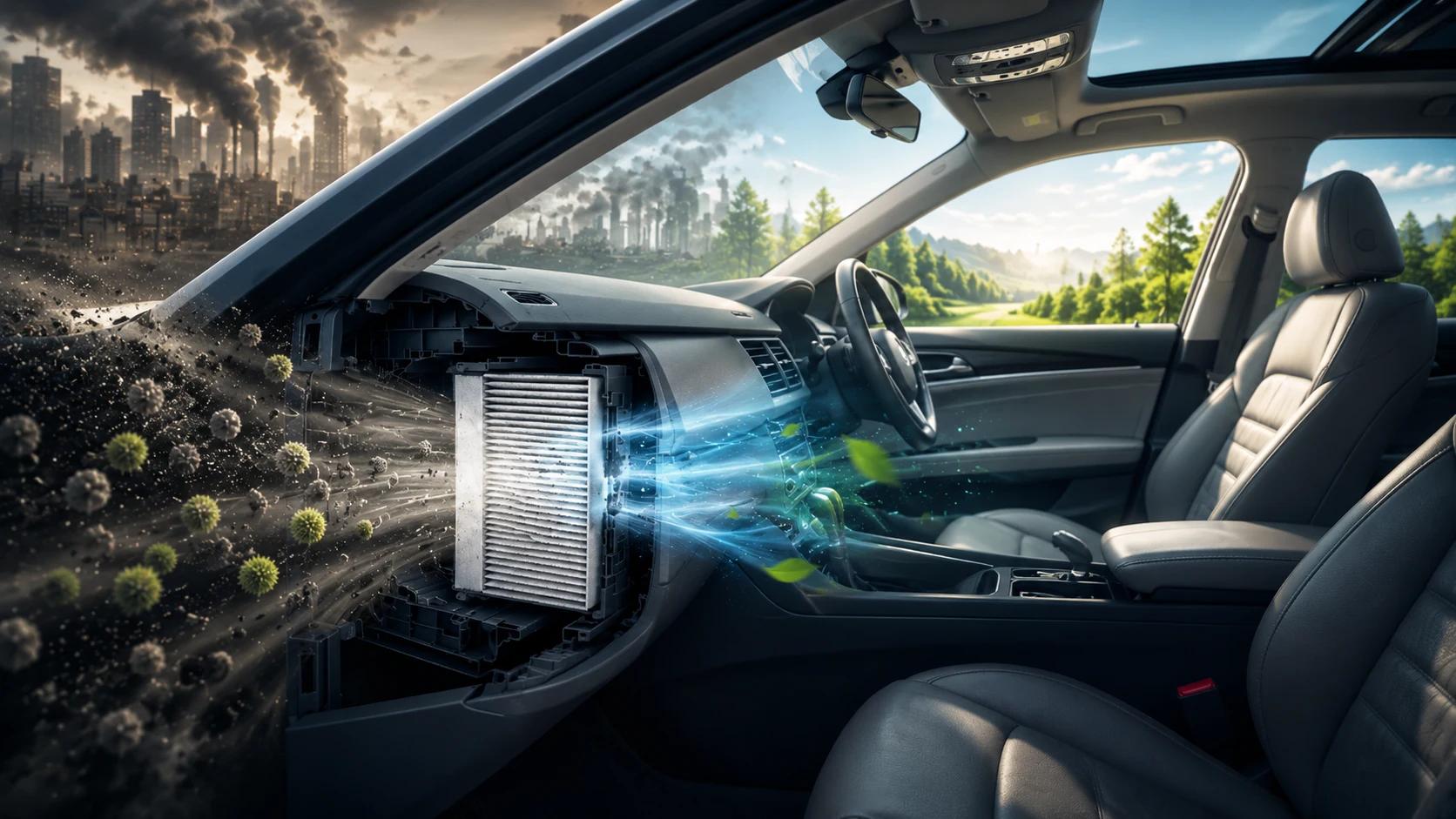
Cabin filters are usually labelled "pollen filter" on the dashboard and that label misleads people — as if it were a seasonal comfort part. In fact it stands between you and five separate threat categories on every trip, all year round.
Pollen and dust: the least dangerous category
Pollen is a threat for 2–3 months per season; for allergy sufferers, daily discomfort. Road dust is constant year-round. Both are caught at 95% and above by standard particulate filter paper. This is what most owners expect of a cabin filter — and it is in fact only a small part of what the filter actually does.
Traffic gases: closest to the driver, invisible
Nitrogen oxides (NOx), sulphur dioxide (SO₂), ozone and volatile organic compounds are direct products of city traffic. The NO₂ in the exhaust of the diesel truck ahead of you reaches the inside of the cabin in under 30 seconds — unless your filter has an activated-carbon layer.
A cabin filter with activated carbon catches 80 to 95% of these gases. A standard particulate-only filter does nothing against this class; the gases pass freely through the filter paper.
Brake and tyre wear particles: very fine, very dangerous
Dust shed from modern brake discs and the very fine fragments thrown up where tyres meet the road — researchers have classified this in the last ten years as a new respiratory threat.
Their sizes range between 0.5 and 2.5 microns. That is the size that penetrates deep into the lungs; the natural defences of the respiratory system cannot catch them. Cabin filters with electrostatic microfibre paper catch this category at meaningful rates.
Mould spores and microbes: covers the HVAC system too
Humidity sticking to the air-conditioning evaporator in wet weather creates a substrate where mould can grow. When the climate blower runs, spores are pumped into the cabin.
Cabin filters treated with antibacterial and antimicrobial coatings stop that growth inside the filter paper. If you smell mould when the AC starts, the problem often begins at the filter.
Five categories, one part
The cabin filter's real job description:
- Pollen and dust
- Traffic gases (NOx, SO₂, ozone, volatile hydrocarbons)
- Brake and tyre wear particles
- Mould spores and microbes
- Exhaust soot
The cabin filter is not a seasonal part, it is a year-round part. The "pollen filter" label on the dashboard is a very small summary of what it actually does.
Filter type in this article